
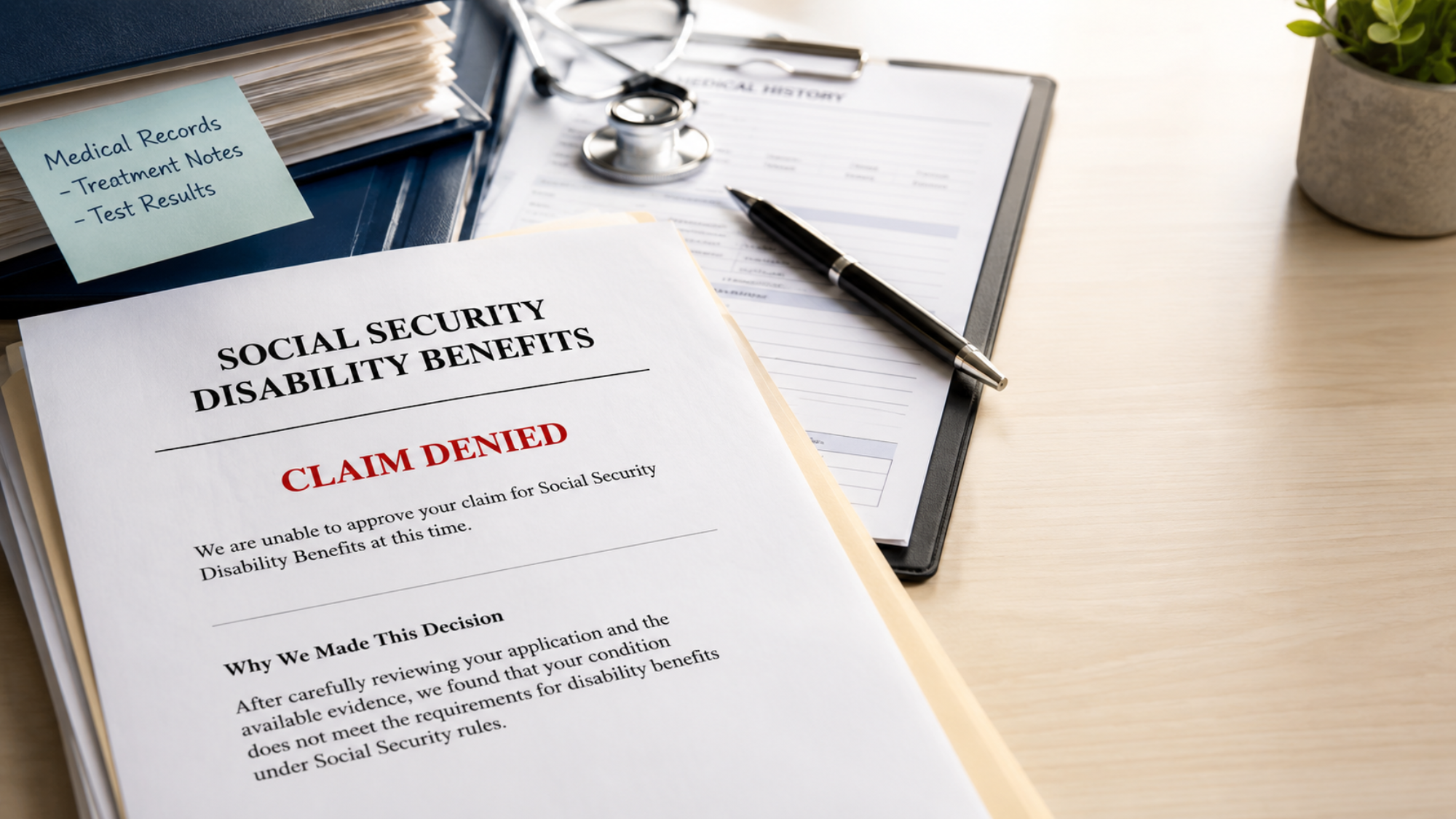
For many Social Security Disability Insurance applicants, the first denial letter feels like the end of the road. In reality, an initial denial is often only the beginning of the disability claims process. SSDI has a strict legal and medical standard, and many claims are denied not because the applicant has no health problems, but because the file does not yet prove disability under Social Security’s rules.
Understanding why claims are denied the first time can help law firms improve claimant education, strengthen intake screening, and develop cases earlier in the process.
SSDI Uses a Strict Definition of Disability
One of the biggest reasons SSDI claims are denied is that Social Security does not evaluate disability the same way a private insurer, employer, doctor, or state program might. SSA states that it pays only for total disability, not partial or short-term disability. To qualify, a claimant generally must be unable to perform substantial gainful work because of a medical condition, be unable to return to past work or adjust to other work, and have a condition expected to last at least 12 consecutive months or result in death.
This standard is difficult for many applicants to understand. A person may be genuinely sick, in pain, or unable to maintain their former job, but the claim can still be denied if SSA believes the person can perform other work in the national economy. That distinction is critical.
Medical Records Often Do Not Tell the Full Story
Many applicants assume that having a diagnosis is enough. It usually is not.
SSA reviews whether the medical condition significantly limits the claimant’s ability to perform basic work-related activities such as standing, walking, lifting, sitting, remembering, concentrating, and carrying out tasks. If the evidence does not clearly show those functional limits for the required duration, the claim may be denied.
This creates a common problem: medical records may confirm treatment, prescriptions, imaging, or diagnoses, but they may not explain how the condition affects the claimant’s ability to work. For example, a record that says “chronic back pain” is less useful than one documenting limitations in sitting, standing, lifting, walking, missed work, medication side effects, and failed treatment.
For attorneys and intake teams, this is where early evidence development matters. The question is not only “Does the claimant have a serious condition?” It is also “Does the record prove work-preclusive limitations under SSA’s framework?”
Work History and Job Details Are Often Incomplete
SSDI claims are not decided on medical evidence alone. SSA also evaluates the claimant’s past work and whether the claimant can still perform that work. SSA explains that it needs information about job titles, duties, dates worked, hours, pay, tools used, lifting requirements, sitting and standing demands, environmental conditions, supervision, and why the claimant stopped or changed work due to the medical condition.
Incomplete work history can weaken a claim. A job title alone may not reflect what the claimant actually did. Two people with the same title may have very different physical or mental job demands. If the application does not clearly describe the real demands of past work, SSA may conclude that the claimant can still perform it.
This is especially important for claimants with physically demanding jobs, inconsistent work histories, self-employment, or jobs that combine multiple roles. A strong work-history narrative can help connect medical limitations to real-world job requirements.
SSA May Decide the Claimant Can Do Other Work
Even when SSA agrees that a claimant cannot return to past work, the analysis may continue. At step five of the disability process, SSA considers whether the claimant can adjust to other work based on medical limitations, age, education, past work experience, and transferable skills. If SSA decides the claimant can perform other work, the claim will be denied.
This is one of the most frustrating denial reasons for claimants. They may know they cannot realistically maintain full-time employment, but SSA may still find that other jobs exist within their functional capacity. These decisions often turn on how well the record documents limitations such as absenteeism, off-task time, pain flares, medication side effects, mental health symptoms, need for breaks, inability to sustain pace, or reduced reliability.
Technical Eligibility Issues Can Lead to Denial
SSDI is an insurance-based program. To qualify, a claimant must have worked in jobs covered by Social Security and have enough recent work credits. SSA explains that disability applicants must have worked long enough and recently enough under Social Security, with the required number of credits depending on the age when disability began.
This means some claims fail before the medical analysis becomes the central issue. A claimant may have a serious impairment but still be denied SSDI if they do not meet insured-status requirements. Intake teams should identify these issues early so claimants understand whether SSDI, SSI, or another path may be more appropriate.
Claimants Miss Deadlines or Fail to Appeal Strategically
An initial denial does not mean the case is over. SSA outlines four appeal opportunities: reconsideration, hearing before an administrative law judge, Appeals Council review, and federal district court action. SSA also notes that claimants may choose an attorney or other qualified person to help with an appeal.
However, many claimants either miss appeal deadlines, file a weak appeal without new supporting evidence, or start over with a new application instead of preserving the appeal path. That can cost valuable time and may affect the strength of the case.
A strong appeal is not just a form submission. It is an opportunity to identify what went wrong, fill medical and vocational gaps, obtain updated treatment records, clarify work history, and address the specific reason SSA denied the claim.
The Initial Application Is Often Underdeveloped
Many first-time SSDI applications are filed by people who are overwhelmed, ill, financially stressed, or unfamiliar with SSA’s criteria. They may provide incomplete medical provider lists, vague symptom descriptions, limited medication history, or short explanations of how their condition affects daily life and work.
That underdevelopment can create a denial even when the claim has merit. The claim file must make the connection between diagnosis, symptoms, treatment, functional limits, work history, and SSA’s disability rules. If that connection is missing, the decision-maker may not have enough evidence to approve the claim.
What Law Firms Should Emphasize in SSDI Claim Development
For disability firms, the high frequency of first-time denials creates both a challenge and an opportunity. Claimants need education before they assume their denial means they have no case. Firms can build trust by explaining that SSDI is evidence-driven and that a denial should be reviewed carefully.
Strong SSDI case development should focus on:
- Whether the claimant meets SSDI work-credit and insured-status requirements.
- Whether the medical evidence documents functional limits, not just diagnoses.
- Whether treating sources have provided complete and current records.
- Whether the work-history report accurately describes actual job demands.
- Whether the denial reason identifies a fixable evidence gap.
- Whether appeal deadlines are being protected.
- Whether the claimant’s symptoms are documented consistently across medical records, forms, and testimony preparation.
The earlier these issues are addressed, the stronger the claim or appeal can become.
Final Takeaway
Most SSDI claims are denied the first time because the system is strict, the evidence standard is demanding, and many initial applications do not fully explain why the claimant cannot sustain work under SSA’s rules. For claimants, a denial should not automatically be viewed as the end of the case. For law firms, it is a key moment to educate, screen, and develop stronger evidence before the next stage of review.